
They were apparently absolute murder to ride, but nothing quite says vintage transportation like the Velocipede. The thing I’ve always found fascinating about these is their huge front wheels. The physics of a bike like this must feel very odd compared to bicycles of today. The force of angular momentum of a wheel (the force that makes it want to stay upright and that leans it when you top turn it) is directly proportional to the torque moment of that wheel. Or, said in non physics babble, the bigger and/or heavier a wheel is, the more stable it is when its rolling. It’s kind of an amazing force, when you think about it. The two tiny rollerblade-like wheels of a little razor scooter generate enough angular momentum to hold an adult upright. In larger, powered two-wheelers like scooters and motorcycles, wheel size makes a huge difference in the character of the machine. Scooters have traditionally had much smaller wheels. Most vintage small-frame Vespas had only 8″ rims, while their large frame brothers weren’t much larger at 10″. My modern Vespa has 12″ wheels, but still feels very much like a scooter — agile, and a tad butt-heavy. Motorcycles tend to have anywhere from 14″ to 22″ rims depending on the style. When I test rode a Triumph Bonneville in 2008, what I noticed immediately was that it took about half the speed I was used to in order to get rolling stability. Once moving, the larger wheels and rolling mass of the Bonneville felt so solid — like it was on rails. What would wheel size mean for the Streetliner?
Bigger front wheels
While playing with the proportions and broad strokes design details of the Streetliner this week, I wondered what would happen if I swapped out Burgman-size front wheels for larger wheels from another bike in the Suzuki fleet. The size of the rear wheel is likely fixed because of the shape of the engine/transmission casings. Big wheels up front would definitely give it a stronger visual connection to the old race car designs that have inspired the project. Especially if I grabbed the spoked wheels off of something like the Boulevard S40. But beyond aesthetics, it would make some significant differences to handling comfort, lean feel, and possibly even make the front suspension easier to build. It looks the business though, doesn’t it?
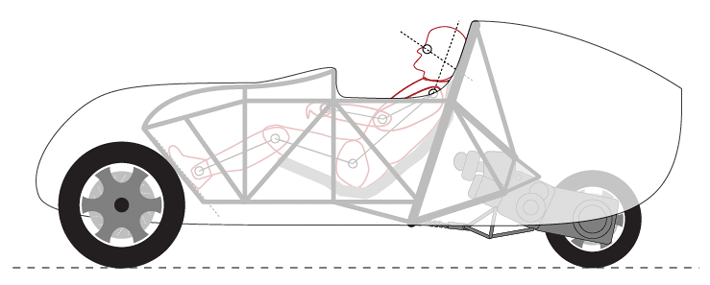
That’s an 18″ rim up front as opposed to the 14″ stock Bergman rim on the rear. It definitely calls back some nostalgic racing mojo. Larger diameter wheels would mean that the front end would take bumps better and have greater rolling stability. It’ll also mean more room inside that wheel for all the tilting mechanicals, brakes, and steering attachments. What it would also mean is that the lower and upper swing arms of the tilting suspension could be further apart — letting me have not only better ground clearance, but deeper leaning on the same distance between the wheels.
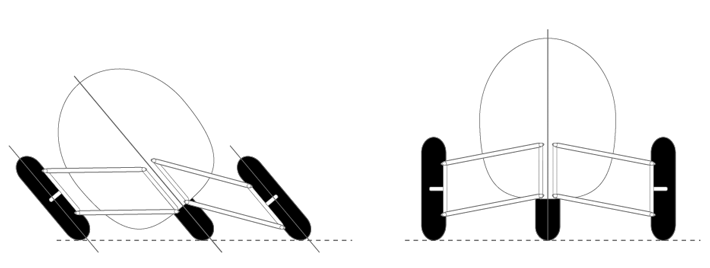
If you go back to my initial lean study, I explored the relationship between body height and leaning. With the larger wheel size up front, a couple of good things happen. First, I’m able to spread the swing arms apart, meaning that at the same lean angle, there’s less interference. This is important at both the wheel attachment points and where the dampening assembly will go (the shocks and their connecting structure, which isn’t shown). The more room there is to work in those assemblies, the better. Not only will it be easier to build, but it’ll mean more opportunity for building fine tuning and adjustment points right into the structure.
Stability
The biggest difference may indeed be felt in leaning stability. The greater mass of those larger wheels would mean nearly instant leaning stability. Whenever I see a Honda Goldwing slowly lean its way through an intersection turn, it amazes me that the 900 lbs or so of the Goldwing are able to be held up at such low speeds. The Goldwing has an 18″ wheel up front and a 16″ wheel in the rear, and that’s enough to keep it stable, even at low speeds. With two 18″ wheels up front, the leaning stability ought to be massive. But more than that, having the swing arms further apart vertically, means that the side-to-side forces generated by the wheels when they precess (based on steering input) will not only be greater, but have more leverage on the body of the vehicle.
The one thing I wonder about, however, is what it will do to the driving feel of the vehicle? Greater stability means that it will take more input force on the steering to induce the lean — and that force will grow with speed. That’s a good thing, as you wouldn’t want the vehicle to be all twitchy at 70 mph. I’m not worried about it, I just wonder what the feel will be. I imagine it wouldn’t be much different than a big cruiser motorcycle with the Tilting Motor Works kit installed.
Wheel pants
From the beginning, I’ve envisioned the Streetliner with wheel pants for added aerodynamics and efficiency. This inspired by both ’30s era aircraft like the Gee Bee but also similar projects like the Aptera. Exposed wheels simply aren’t very aerodynamic. Putting a streamlined shroud around the wheels will add effeciency (and look fantastic). However, I’m not exactly sure just how much efficiency is gained. Adding wheel pants will definitely add time and complexity to the build, and at some point I’m going to have to do an aerodynamics study to see how much more efficient the shrouded wheel is than a naked wheel. One thing I have to keep in mind though, is that unless I can put a decent tail on the pants, there won’t be much advantage in the wind. However, that tail will quickly limit how far I can turn the wheels (because the tail of the pants will hit the body). That means a large turning radius, and for a vehicle intended for mostly city use, that’s not a good thing. So if I have to sacrifice wheel pants for the sake of turning ability, that’s a compromise I can’t not make. But I do just love the look of the pants. I hope I get to keep them.
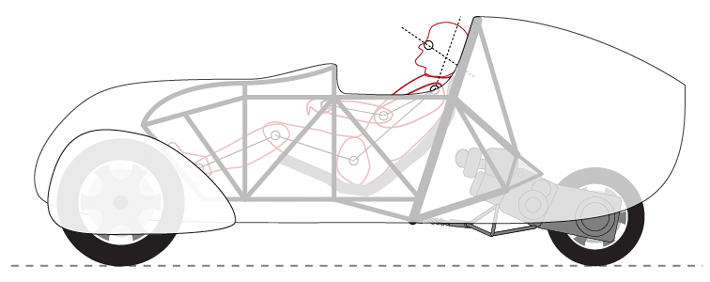
Here’s a source for info on the wheel pants from someone who faired a little 125cc Honda scooter. He found that fairing the wheel by itself made it FAR too squirrely to ride in a crosswind. But by fairing completely around the front wheel without attaching the fairing to the wheel itself, stability inproved considerably. Apparently the effect is from the center of wind pressure on the wheel causing it to steer or weathervane in the wind.
PS. I like the wheel pants too, hope you get to keep them.
http://www.velomobiel.nl/allert/Recumbent%20motorbike.htm
About 1/3 of the way down the page, under the section titled…
“What is good and what has to change”
“The front wheel fairing has to go to. I was quite confident that it would work and not affect the steering to much. It turned out to be very scary to ride even with as little as 3 beaufort (about 10mph) side wind I did not dare to go over 35mph. It is a pity I made a mould and all without ever testing with a cardboard model. Now I am forced to change the design drastically. A non streamlined front wheel would induce far too much drag and is therefore unacceptable. The front wheel needs to be inside the streamline without being connected to it. “
Yeah, I’ve seen this project but missed that bit about the front wheel. Perhaps I have to curtail my tail when it comes to wheel pants. Even if I simply wrapped the wheel round and tight and left the tails off, it’d be much more aerodynamic than the naked rim, if not as slippery as a fully streamlined wheel pant shape. A second alternative could also be to widen the pants such that they’re still attached to the tilt, but the wheels turn inside the pants. That way the fairing can’t make wayward steering inputs, but still covers the wheels.
Hi again Nathaniel, I was wondering how you make the vehicle lean….can you force it? Can it stay upright while on a sloping surface? I want to keep my vehicle light enough so that human power would still be effective.
Thank you, Gordon Hoffman
Gordon,
The vehicle leans organically, just like a motorcycle. It’s a combination of angular momentum and inertia, again, just like a motorcycle. On a motorcycle, you “counter-steer” — that is, you actually turn the handlebars left to lean the vehicle right. This happens because of two factors. The first is angular momentum — the gyroscopic effect of spinning wheels that causes them to resist motion not in their axis of motion. That resistance “reacts” to inputs at 90º to that input. So a “turning” input on the front wheel(s) from above causes a reaction for the wheel to rotate at 90º to that input — which results in a lean. The second half of leaning and vehicle stability is just inertia. Because a motorcycle (or my vehicle through the mechanics of the front suspension) is able to fall over, you actually use gravity and inertia to make the vehicle lean into a turn by turning in the opposite direction for just an instant before turning back into that turn. It’s kinda tough to visualize, but in a way, you’re sort of turning into that turn just slighty faster than your falling over and the sum of those forces is a stable lean that is then supplemented by the angular momentum of the wheels.
Hope that helps.
Hi..your research is fantastic….I was just about to start welding something up along the same lines but using a SmartCar body shell with longer wishbones on the front, when I came across your thread..have you built your car yet,or have you come up with a definitive plan at least for the front end?
Kind Regards
Nigel
Thanks, Nigel!
I have not started fabrication as of yet. I’m actually working separately on some motorcycle projects to do the necessary skill acquisition to be able to actually tackle this project.
As for my plans for the front end, I intend to pretty much copy the Leanster verbatim. I’ll be doing it first in a small-scale prototype, then if that works successfully, that’ll be what I build full-scale. One thing that I think is really smart about their approach is that there are multiple adjustment points on their suspension that allows them to reconfigure and adjust the suspension geometry. I think between that and dialing in the shock absorber choices, the front end ought to be pretty straightforward. I’ll be using just tube steel and off-the-shelf bushings and bearings. The only complicated piece of custom fabrication will likely be the steering kunckle / hub assemblies, but even those should be pretty simple in the grand scheme of things.
I’m concerned that your understanding of how a motorcycle works / leans / stability is way off. Which is really common, because it’s confusing.
It has nothing to do with gyroscopic effect, and everything to do with rake and trail. They combine to point the front wheel in the direction in which it is leaning. So you counter-steer to get it to fall in the direction you want to turn, then the rake and trail keep the wheel pointed in a useful direction.
“The two tiny rollerblade-like wheels of a little razor scooter generate enough angular momentum to hold an adult upright.” *twitch*… nope.
I had read the same piece on wheel pants and side wind loading,as Aaron talks about.The fact you have two front tires[twice the contact patch] pretty much eliminates any real wind effect.I didn’t hear or read about any problem with the Aptera concept car.As a side note,VW may start production on it’s concept vehicle ,the XL1,they claim 200 plus mpg usa, 1Litre/100Km + no price as of yet or if they will sell it in the USA.Its worth a look,if you love aerodynamic vehicles,its really slick.uses a 800 cc 47 HP diesel and 27 horse power electric motor.It takes just 8 horse power to cruise at 62 mph.Plans call for 50 vehicles,and I’m guessing if the demand is high,they will ramp up production.Lets hope this isn’t another over budget concept car,with a rich boys price tag.This could be the start of a revolution in vehicle design.
A longer wheel base and keeping most of the surface area behind the center of gravity is in effect like the feathers on a arrow or a vertical stabilizer with a rudder on a airplane. Peraves built glider’s before building the Ecomobile,Monotracer so I guess they applied some of the knowledge they had learned.If any of you remember the early days,Mr.Wagner had a single seat,short wheelbase Ecomobile with a turbochaged BMW MC engine.Because of the short wheelbase and limited body behind the C and G he had to add vertical stabilizer with a rudder[I believe it was fixed straight,I can’t imagine using the rudder on a motorcycle at speed].OMG!!!!
Craig Vetter talks about the relationship between center of aerodynamic pressure and the center of gravity and how that effects stability. I’ll definitely be taking that into account on this. With three wheels though, it might be less critical given the long wheelbase and wide stance.
Hi,
I am intrigued by your concept vehicle. Having ridden a Quadro 350 s three wheeler for over a year now – I am hugely impressed by the safety and fun factor of using the tilting concept on a machine that handles almost exactly like a motorcycle. The Quadro is very similar to the Piaggio MP3 (except it is lighter has lower centre of gravity and has only a passive hydraulic leaning system – no pumps or electronics apparently – pure simplicity) The same guy who designed the MP3 designed the Quadro. The Quardo website is here : http://www.quadrovehicles.com I am more than happy to give my insights into my experiences of my tilting bike if you get in touch. Good luck Russ (Ireland)